Need Help?

Display technology is a leading force in innovation during this digital era, influencing our interaction with information, entertainment, and the world. The advancement of monitor technology, from smartphones to high-definition TVs, has significantly changed how consumers view and interact with visual content.
LCD is a flat panel display requiring liquid crystals to operate. LCDs have several use cases for consumers and businesses and are commonly found in smartphones, TVs, computer monitors, and instrument panels. LCDs were a significant advancement, making displays thinner than cathode ray technology (CRTs). These displays work on blocking light; thus, they require less electricity than LED and gas-display screens. They also generate less heat and are more energy-efficient, making them ideal for battery-powered devices like laptops and handheld gadgets.
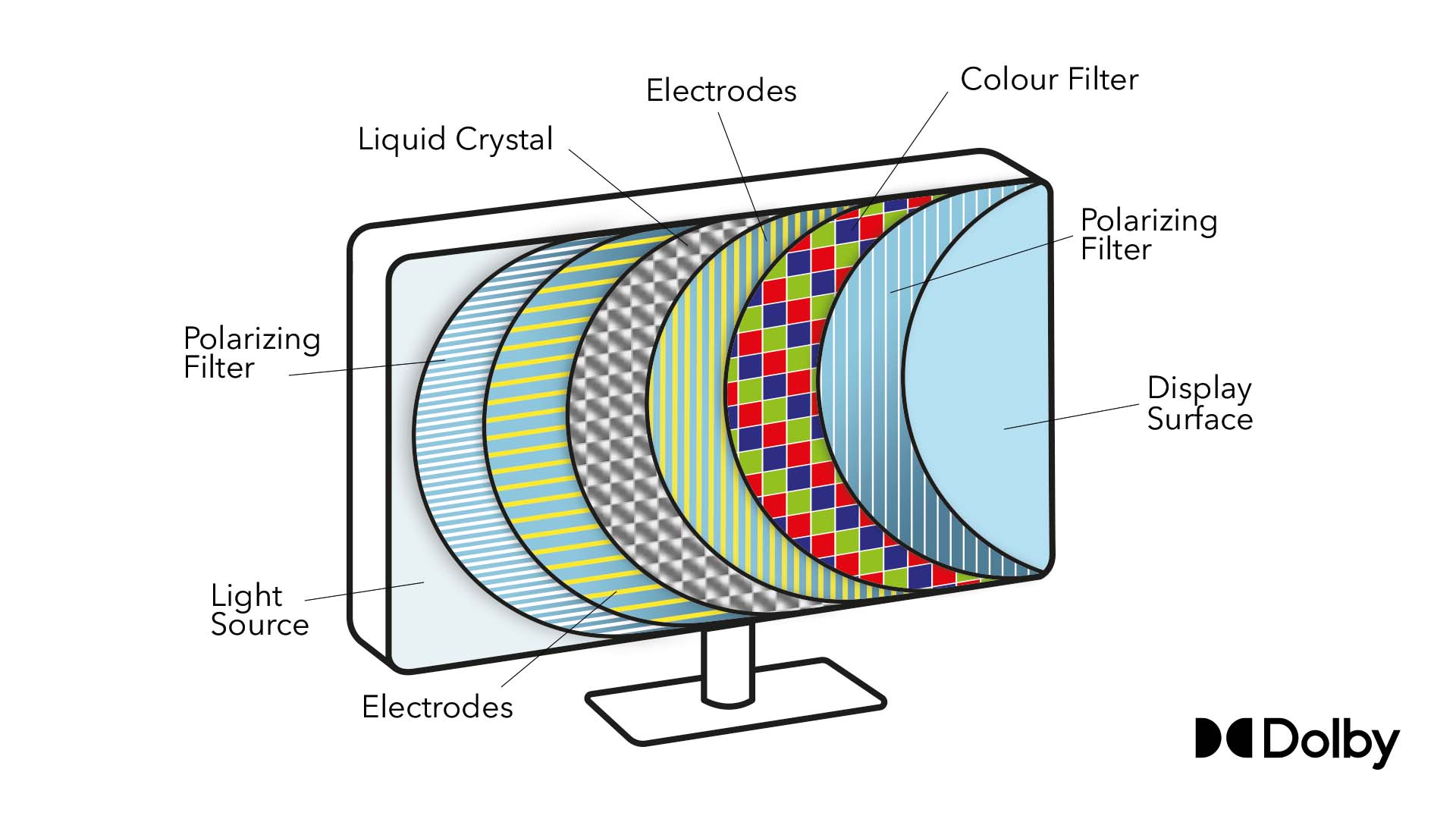
A display has millions of pixels. Each type of display controls pixels differently: CRT, LED, LCD, and newer. LCDs have a backlight and electronically switch pixels, while liquid crystals rotate polarized light. All pixels have a 90-degree polarizing glass filter in front and behind. The liquid crystals between the two filters can be electronically activated and deactivated. When voltage is applied, the crystals change their alignment, which adjusts how much light passes through. This lets the screen display images, colors, and brightness levels. Color is created by dividing each pixel into red, green, and blue subpixels, which combine in different ways to form millions of colors.
OLED technology has significantly impacted display markets with its innovative approach to image production. Unlike traditional displays that require a backlight, OLED displays are composed of self-emitting pixels, each capable of producing its own light. This fundamental difference allows for much thinner designs, exceptional black levels due to the ability of pixels to turn off completely, and enhanced contrast ratios, with each pixel acting as its own dimming zone. Furthermore, OLED improves viewing angles dramatically, maintaining color accuracy and consistency across a broad spectrum of viewing positions. Within the OLED category, there are two primary types: WOLED (White OLED) and RGB OLED, each with distinct manufacturing processes and performance characteristics.
WOLED (White OLED)
WOLED technology involves the use of white organic light-emitting diodes to generate light. A key feature of WOLED displays is the color filter array placed in front of the white OLED layer, which separates the white light into RGB (red, green, and blue) components. This process is somewhat akin to how traditional LCDs operate but without the need for a backlight. The major advantage of WOLED is its simplicity in manufacturing and uniformity in brightness and color across the display. WOLED is predominantly used in large-screen TVs and some types of monitors, offering excellent color accuracy, energy efficiency, and contrast ratios. However, since it relies on a color filter, some light efficiency is lost compared to directly emitting RGB OLED displays.
RGB OLED
RGB OLED displays, on the other hand, employ individual red, green, and blue OLED sub-pixels to create the full spectrum of colors. This direct emission of color from each pixel results in more vibrant colors and higher efficiency than WOLED, as there's no loss of light through a color filter. The manufacturing process for RGB OLED is more complex, requiring precise control over the deposition of organic materials for each sub-pixel. This complexity often leads to higher production costs, especially for large displays. RGB OLED is frequently used in smaller devices, such as smartphones and tablets, where its color vibrancy and efficiency are most advantageous.
Differences Between WOLED and RGB OLED
The primary difference between WOLED and RGB OLED lies in their approach to color production. WOLED uses a white light source combined with a color filter, offering a simpler manufacturing process but at the expense of some light efficiency. RGB OLED, with its direct emission of colored light from each pixel, boasts higher vibrancy and energy efficiency but comes with increased manufacturing complexity and cost. Both technologies share the core benefits of OLED, including deep blacks and wide viewing angles, making the choice between them a matter of application, cost, and desired display characteristics.
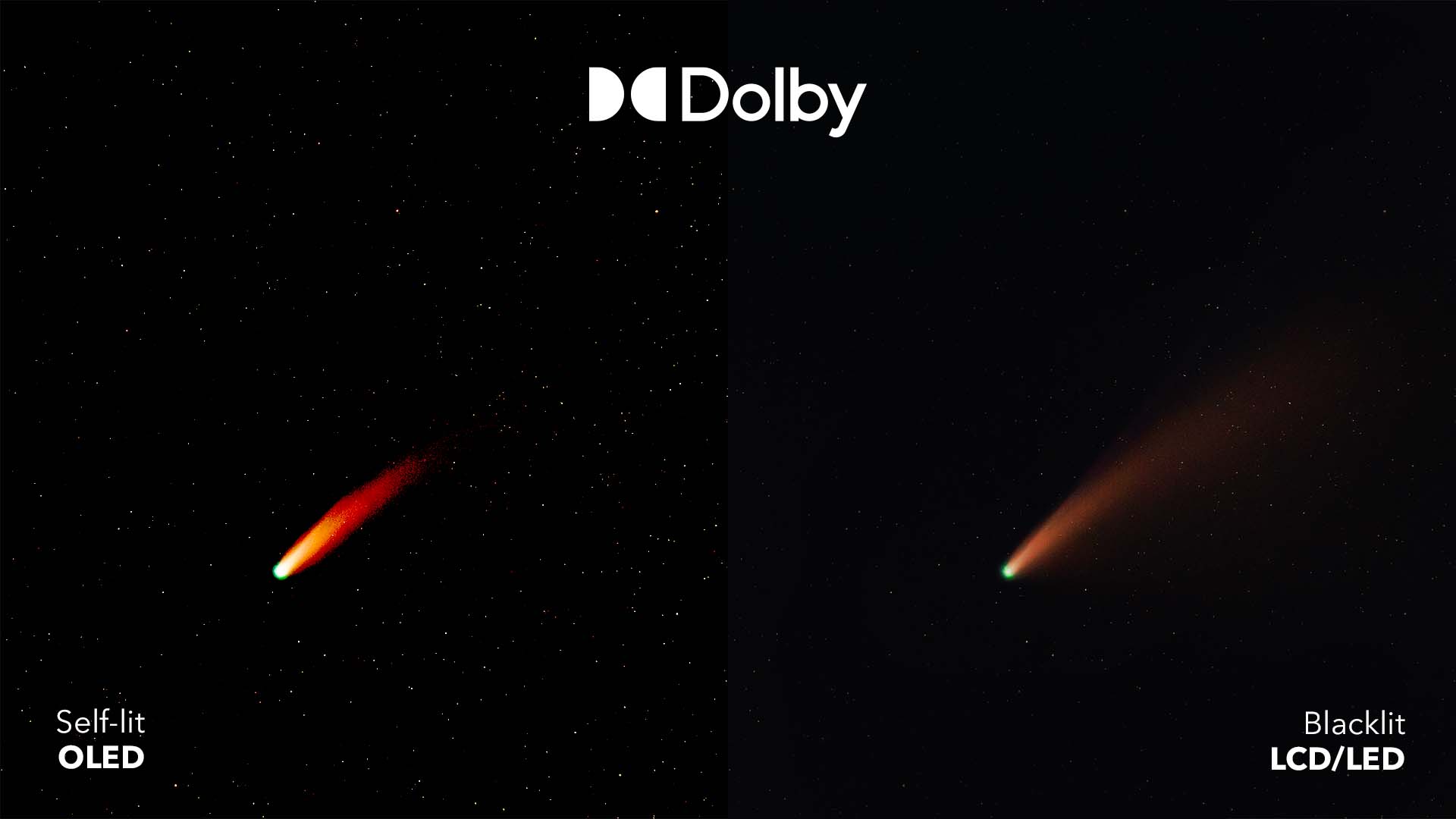
The stars are much more visible on the OLED display and the comet's tail is sharp.
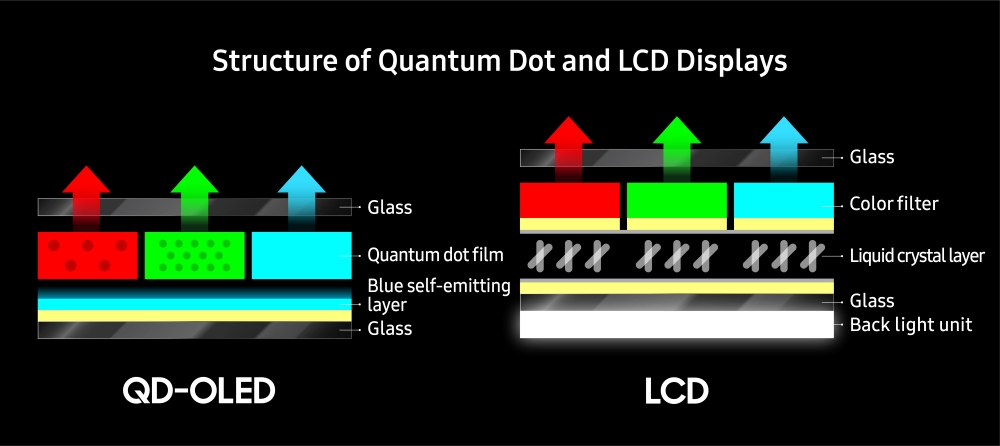
QLED, short for Quantum Dot LED, is a display technology based on traditional LCD panels but enhanced with quantum dots to improve color reproduction and brightness. Although the name might suggest it’s a kind of OLED, it’s not. QLED displays still rely on a backlight, typically made of blue or white LEDs. This backlight shines through a layer of quantum dots — extremely small semiconductor particles, just a few nanometers in size. These quantum dots emit specific colors depending on their size, when struck by light. In QLED screens, the blue light from the LED backlight passes through a film of quantum dots. Some of this blue light is converted into highly pure red and green light by the dots, while the rest remains blue. The result is a highly saturated RGB light source, which then passes through the LCD panel. The LCD panel itself uses liquid crystals and color filters to selectively allow portions of the RGB light through, forming the final image on the screen. Because QLEDs still use a backlight, they cannot achieve perfect blacks — even the darkest parts of the screen emit some light — but they are capable of producing high brightness and vivid colors, especially in bright rooms.
QD-OLED, or Quantum Dot OLED, is a more advanced and fundamentally different technology. Unlike QLED, it does not rely on a backlight. Instead, each pixel in a QD-OLED screen generates its own light — this is known as a self-emissive display. The foundation of QD-OLED is a layer of blue OLED pixels, which emit blue light when electricity passes through them. Above this OLED layer lies a quantum dot conversion layer. This layer contains quantum dots tuned to absorb the blue OLED light and re-emit it as red or green, depending on their type. Pixels that are meant to be blue simply let the blue OLED light pass through unchanged. This means each pixel on the screen can emit red, green, or blue light directly, with no need for a separate backlight or traditional LCD structure. The combination of OLED’s pixel-level light control and the quantum dots’ ability to generate precise colors leads to outstanding image quality. QD-OLED screens are capable of perfect blacks — since pixels can turn off completely — and offer incredibly high contrast and color accuracy. The color purity is also improved compared to traditional OLED because quantum dots are more efficient at converting light than standard color filters. However, because they rely on OLED emitters, QD-OLED displays can still face issues like image retention or burn-in over time, though modern designs significantly reduce this risk. In short, QLED is an enhanced form of LCD that uses quantum dots to improve light quality before it passes through a liquid crystal filter, while QD-OLED is a newer, hybrid approach where each pixel lights up by itself and uses quantum dots to achieve stunning, accurate color with no need for a backlight.
| Feature | LCD (LED-LCD) | QLED (Quantum Dot LCD) | OLED (RGB / WOLED) | QD-OLED |
|---|---|---|---|---|
| Type | Non-emissive (needs backlight) | Non-emissive (LCD + quantum dots) | Self-emissive (each pixel emits light) | Self-emissive (blue OLED + quantum dots) |
| Backlight | Yes — LED | Yes — Blue LED + Quantum Dots | No — each pixel emits its own light | No — blue OLED pixels emit light |
| Light Control | Liquid crystals block or allow backlight | Same as LCD | Electric current controls pixel brightness | Same as OLED |
| Color Creation | RGB filters on white backlight | Quantum dots convert blue light to RGB | RGB OLED or white OLED through color filters | Quantum dots convert blue light to RGB |
| Color Accuracy | Good | Very good | Excellent | Excellent (better than WOLED) |
| Black Levels | Poor — backlight leakage | Better (local dimming helps) | Perfect — pixels turn off completely | Perfect — pixels turn off completely |
| Contrast Ratio | Low to medium | Medium to high | Infinite (perfect black + bright) | Infinite |
| Brightness | High | Very high (quantum dots boost brightness) | Medium to high (depends on panel) | High — brighter than WOLED |
| Viewing Angles | Narrow — color shifts from side | Medium — better but still fades | Excellent — consistent at all angles | Excellent |
| Burn-in Risk | None | None | Possible (long-term static image retention) | Possible (same OLED risks) |
| Energy Efficiency | Efficient | Efficient (slightly better than LCD) | Lower on white images (filters reduce output) | Better efficiency than WOLED |
| Cost | Cheapest | Slightly more than LCD | Expensive (especially RGB OLED) | Most expensive currently |
| Lifespan | Long | Long | Good, though blue OLED degrades faster | Good, still being proven long-term |
| Used In | Budget TVs, monitors, laptops, appliances | Mid to high-end TVs (Samsung, TCL) | High-end TVs, phones, tablets (LG, iPhone, Sony) | Premium TVs (Samsung, Sony), gaming monitors |
| Manufacturers | LG, Samsung, TCL, many | Samsung, TCL, Hisense | LG Display, Sony, Apple (phones) | Samsung Display (panels), Sony, Alienware |